Analysis profile
Hadron spectroscopy
LHCb · Λc⁺ → pK⁻π⁺
Forward model (Measure)The released helicity amplitudes define an unnormalized intensity; phase-space integration supplies the normalization.
| Forward | 0.025 core-h |
|---|---|
| Params | 100 |
| Analysis | 25 core-h |
| Input | 10 MB |
| Tools | 2 |
| Code | 10000 LOC |
| Cites | 10 |
Forward cost measured for 400,000 events on one core after warm-up. Analysis cost estimates 1,000 forward passes; other metrics are approximate.
About this profile
An unnormalized intensity, amplitude, or theory-response model. Normalization or an observation model is supplied separately.
Metrics describe the scoped analysis and are approximate unless explicitly measured. Colored squares show metric-specific size bands; they are not scores. “Cites” is a reference-count estimate, not a live citation count.
LHCb · \(\Lambda_c^+\to p K^- \pi^+\) 
Follow the coherent sum of resonance amplitudes that describes a charm baryon decay, from model components to mass projections.
Reproduction status
Reported reproduction. Independent validation pending. Status updated 2026-07-14.
Scientific model 
Combine helicity decay chains, lineshapes and complex couplings into an intensity, then project it over three-body phase space.
The published analysis fits the amplitude model and polarization. The current reproduction evaluates and projects the released forward model only.
Model ingredients 
Reusing this model requires the ingredients below. Availability and limitations are described in the reproduction evidence.
- Particle identities and ordering
- decay topology and Dalitz variables
- helicity and spin conventions
- resonance lineshapes and form factors
- complex couplings and fit fractions
- efficiency and background descriptions
- covariance information and alternative amplitude models.
Reproduction objective and evidence 
Objective: Figure 3 projection of the released \(\Lambda_c^+\to p K^- \pi^+\) helicity-amplitude forward model
Scope and limitations: The forward model is reproduced; the original data and simulated-event tuples are unavailable. This does not reproduce the likelihood fit, detector acceptance or parameter uncertainties. Independent audit pending.
Released model and reported checks 
The released Julia implementation uses ThreeBodyDecays.jl. The reported checks used version 0.7.0, commit 99860344a18dfabd51c0c2b69933308861ccc4e6, with Julia 1.11.5.
The default model has 26 decay chains. It combines sequential helicity vertices, resonance lineshapes and complex couplings; Wigner rotations align spin states before coherent summation. Spin sums or density-matrix contractions give the intensity.
At the reference point
m²(Kπ) = 0.7980703453578917 GeV²
m²(πp) = 3.6486261122281745 GeV²
(2λp, 2λπ, 2λK; 2hΛc) = (1, 0, 0; 1)
the reported intensity is 9345.853380852272 and helicity amplitude -45.132326950250516 + 54.85942516648609i. The reported upstream test run passed 24 assertions.
The Figure 3 comparison generates model projections over the Dalitz plane. The coherent total and individual resonance components are the target; the black publication data points are not regenerated. Tested alternative amplitude models are part of what needs preserving, together with the default model.
A reported 400,000-event, single-thread benchmark took about 0.025 core-hours after warm-up. The approximately 25 core-hour full-analysis figure is an estimate of 1,000 forward passes, not a measured fit.
To inspect and test the pinned public implementation:
git clone https://github.com/mmikhasenko/Lc2ppiKSemileptonicModelLHCb.jl
cd Lc2ppiKSemileptonicModelLHCb.jl
git checkout 99860344a18dfabd51c0c2b69933308861ccc4e6
julia --project=. -e 'using Pkg; Pkg.instantiate(); Pkg.test()'
The companion polarimeter study uses this amplitude model. A future encoding with reusable decay blocks should retain the reference-point tests and make phase, particle-ordering and spin conventions explicit.
Figures 
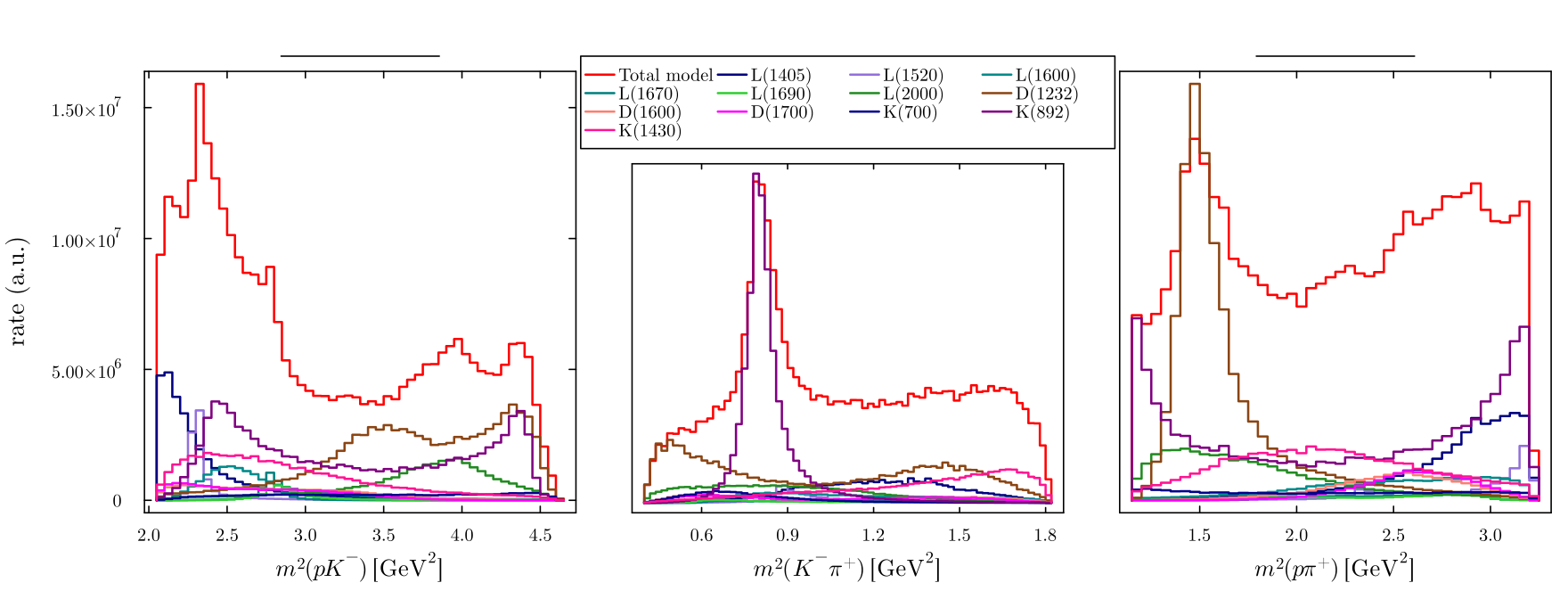
Reproduced model prediction or comparison with published results.
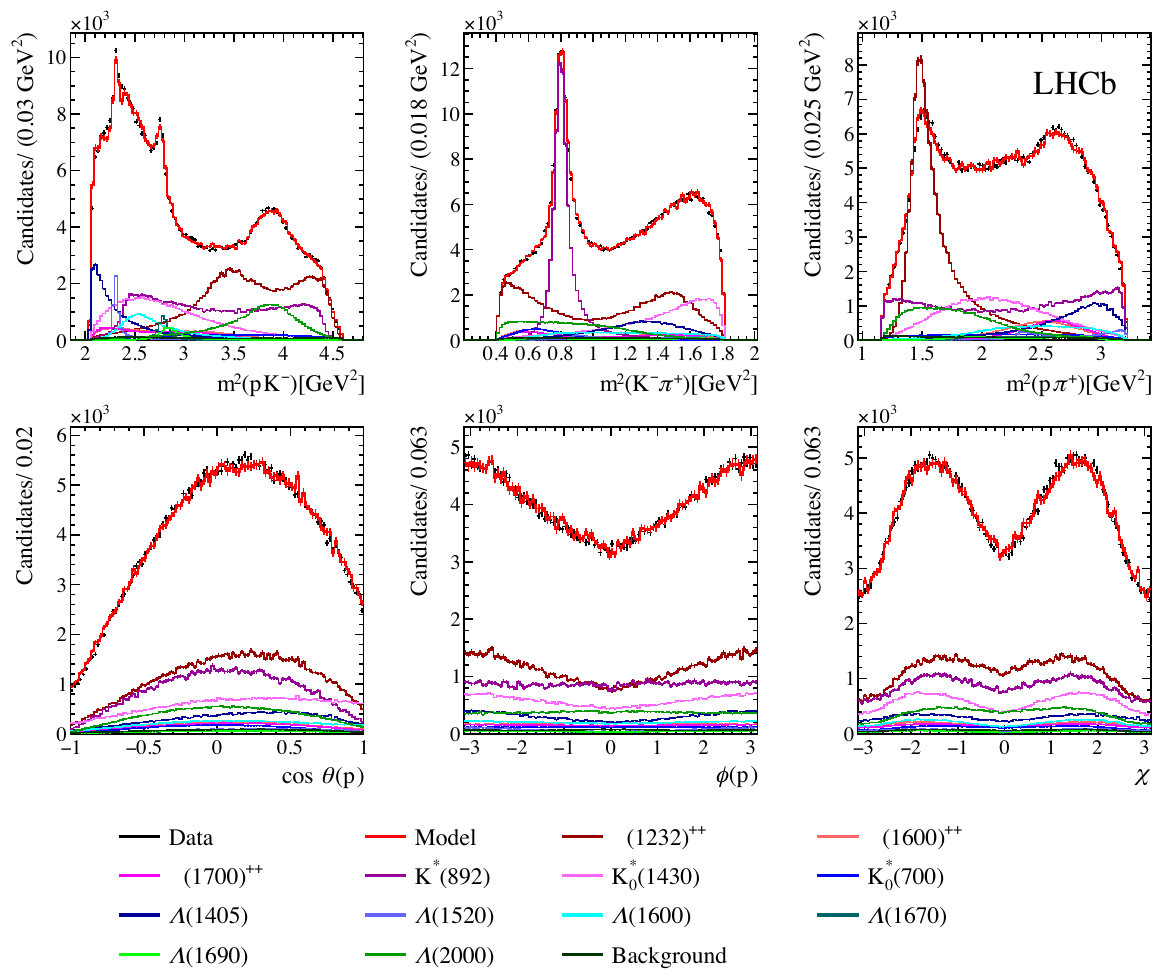
Reference figure from the publication cited below.
Publications 
- Amplitude analysis of the \(\Lambda_c^+\to p K^- \pi^+\) decay and \(\Lambda_c^+\) baryon polarization measurement in semileptonic beauty hadron decays (2023) · DOI: 10.1103/PhysRevD.108.012023 · arXiv:2208.03262